
I got rejected from SSE. Then, taught the accepted cohort.
Editor-in-Chief Daniel Alestrand shares how a university rejection made him the youngest in Europe ever to present a university seminar.
I was 15 when I first heard about the Stockholm School of Economics (SSE); the business school was doing outreach for students in Britain hoping to enter their bachelor programme. My teacher let me leave a couple minutes early so I could make the train towards London Waterloo.
Children my age were sitting around the couch with their parents in this swanky hotel I never knew existed. I knew the competition to enter the institution would be tough after seeing the Eton-filled thread email thread. Nonetheless, I thought I'd give it a shot.
Using money I had saved from my tutoring job, I was finally allowed to fly alone at 16 years-old. My cousin who lived in Stockholm with her now-wife let me stay in their apartment while in Malmö. There was a random lecture on Masters-level economics which I booked and an email to admissions waiting for a response. I wanted to book a tour.
Eyes started at me as I walked in the only bag I brought with me, a suitcase which surpassed me in age. Rolling up to the front row, I sat next to a student and opened up my laptop to take notes. As assumed, the lecture was slightly too advanced so the student next to me walked me through what it all meant. An amalgam of politics and statistics can really mess with your head!
Turns out, I had got a confirmation for the tour so set sail the following morning. It was with a girl my age and a mother who was twinned in what could only be Filippa K. It's safe to say I'm still influenced by their style. We walked around and learned about the artwork, SASSE and all the little quirks this school has to offer. It was my dream come true. A place I knew was perfect for me.
My first application was rejected: I couldn't apply with predicted grades and my SAT score narrowly missed the mark. Devastated, I knew that the next year would be for me. I resat the SAT and scored around the median acceptance score, wrote a killer application and prayed this would be it. It wasn't: I accidentally uploaded the wrong grades, Antagning wouldn't let me delete it and my dream to do a bachelors at SSE was crushed.
I cried. I brushed it off. I purchased another ticket to Sweden. If being an SSE student wasn't a reality, my heart knew there would be something for me. Before the flight, I joined the waitlist to attend a fully-booked seminar on embodied technologies. The class that changed my life.
What felt like fate, I found out hours before that my booking was confirmed. The entire lecture I made sure to fully contribute, ask a few philosophical questions and make the most out of it.
Professor Eleu stayed behind and asked if I wanted to see the House of Innovation and its research lab. I felt my throat drop to my stomach. The simple "yes please" I gave in response changed my life.
My old MacBook was plugged into the extension cord. A ton of research papers were downloaded. And, I got to work reading and making notes. The most fascinating topic was Brain-Computer Interfaces (BCI) which I explored deeper and deeper. Eleu was impressed and offered to let me read more.
Sleeping at my Dad's cousin's place, I got permission to stay an extra week and extended my flights to research more.
My neurodivergent brain was entranced in this world of BCIs, the opportunities they bring and the future implications of such technologies. There's a video which I've linked below showcasing a BCI. Showing this to Eleu, she asked how I'd feel presenting a university seminar on my findings for SSE's tech initiative.
The seminar was approved. My name was officially on the Stockholm School of Economics' website. The feeling I got could only be described as euphoric. I was actually doing this.
It was December 2nd and the snow had finally reached the city. It was nothing short of perfect. Eleu and I booked a meeting room to refine the presentation and rehearse for the seminar which would occur in less than 24 hours. History would be made.
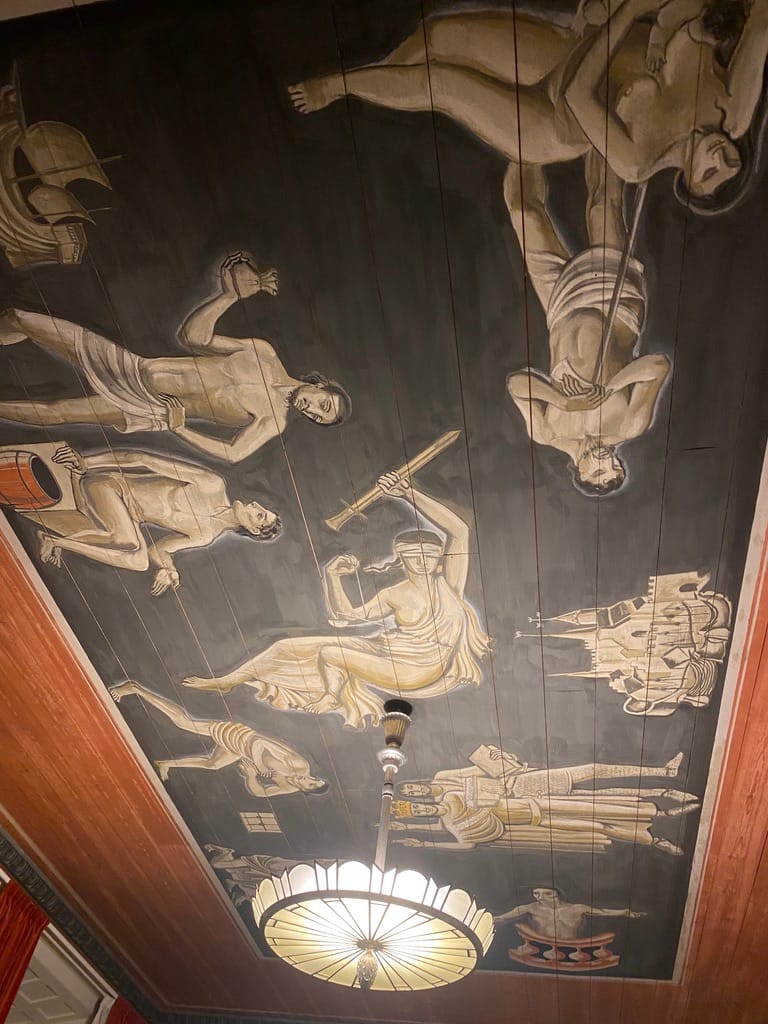
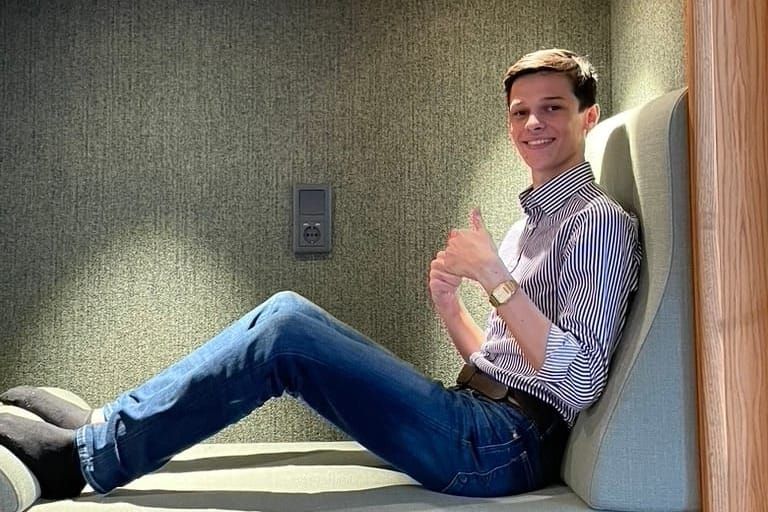
After a long rest, I put on a slightly-too-small shirt, rolled my cuffs to hide it and boarded the tunnelbana to Stockholm Odenplan. It was then when I found out the seminar would take place in the cabinet room, designed by 8 artists with cubby holes that students could sit in (hence the photo).
To my surprise, a member from the admissions team took a seat at the back and watched while I talked about the "BCI big 4," identity theory and the impact that Brain-Computer Interfaces might have on society.
Overcoming the nerves, 18 year-old me became the youngest person in Europe ever to present a university seminar. And, recognising a few aces who were in the cohort I was rejected from, meant that I had taught them.
A member from SSE Executive Education came up to me once the seminar was finished and expressed interest in the topic. She shared that it would be great to have us potentially present seminars more to alumni.
Turns out, it got approved and shortly I found myself in the gorgeous Campus Kämpasten drinking a cup of tea while we waited to present. Having done this before, I stuck my chin high and remained as confident as possible as I co-presented BCIs once again.
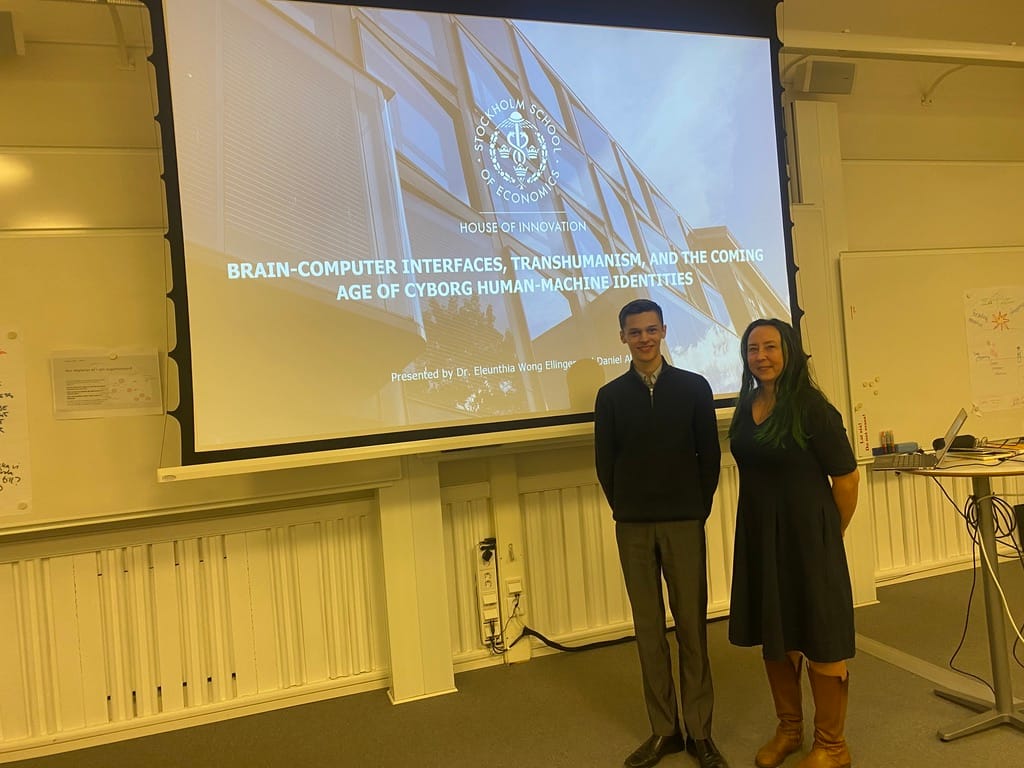
It felt strange teaching industry leaders as someone who had just turned 19. However, it took a quick reminder of the time and research I had spent to realise that age is never a factor. What really mattered was courage, commitment and a lot of time researching. And, to my surprise, I received another phone call saying that we've got another seminar to teach.
Walking through SSE's corridors and recognising familiar faces who had made this dream possible. It began to feel like home. While I never got to fulfil my dream of becoming a student there, it opened doors bigger than I imagined. Thanks to this, I was offered a place at Durham University where I'm about to enter my second year of studies.